
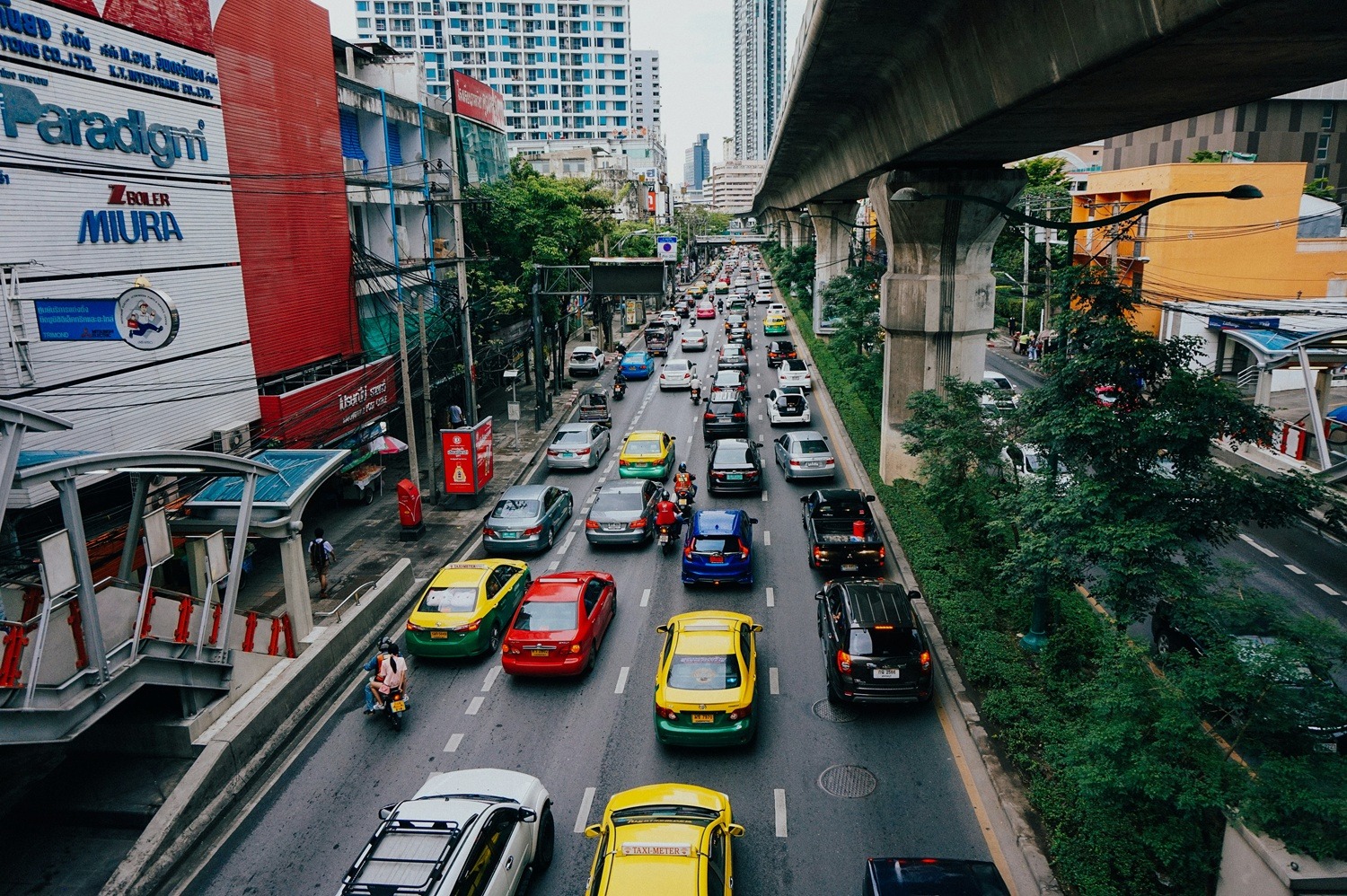
Highlights how data, AI and continuous evaluation can help identify and address road risks
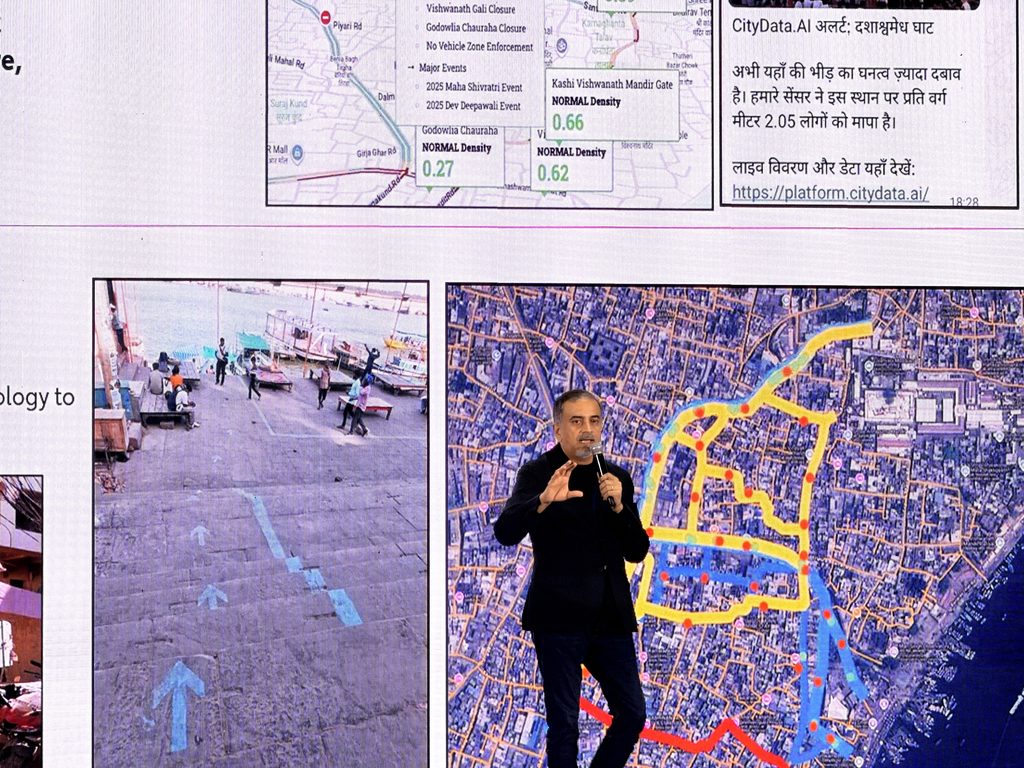
23 November 2026, Bangkok, Thailand – The Toyota Mobility Foundation (TMF) showcased the TRUST (Thailand Road Users Safety through Technology) Project at Thailand Smart City Expo 2026 on 18 November and the 17th Thailand Road Safety Seminar on 20 November. Through presentations by Pras Ganesh, Executive Program Director of TMF, the two events highlighted how data-driven analysis and emerging technologies can support a more proactive approach to road safety in Bangkok and provide a model that can be adapted in other areas. The presentations focused on the TRUST approach: combining vehicle probe data, drone and video analytics, and on-the-ground observations to better understand how road users interact with one another and with road infrastructure. By looking beyond reported crashes and examining patterns of potentially hazardous interactions, the project aims to help responsible agencies identify risks earlier, prioritize responses and assess whether interventions are working.
Launched in April 2025, the TRUST Project is a collaborative initiative involving the Toyota Mobility Foundation (TMF), Bangkok Metropolitan Administration (BMA), UN-Habitat, Asian Institute of Technology (AIT), Toyota Motor Thailand Co., Ltd. (TMT), and Road Accident Victims Protection Co., Ltd. (RVP). The project applies data and technology to examine road safety through three interconnected dimensions: people, roads and infrastructure, and vehicles.
Rather than applying a single standard solution, the partners combine analytical evidence with local knowledge to validate root causes and co-develop countermeasures suited to each location.
“Data and advanced analytics give us a more objective understanding of traffic safety, helping uncover insights that may not always be visible through conventional observation alone. While these tools can help reduce reliance on potential human bias, as Toyota Mobility Foundation we recognize that local knowledge and human perspectives remain essential to understanding the real context of road users.
We believe that emerging technologies with human insights can accelerate the way we identify problems, develop precise and more cost-effective solutions and evaluate their effectiveness. By using technological evidence to guide practical, targeted interventions, we can develop meaningful approaches that can be adapted and scaled to other locations.”
A Proactive Approach: From Data to Continuous Improvement
The project has now progressed from blackspot identification and root-cause analysis to stakeholder-led countermeasure implementation and monitoring, with findings used to refine measures where needed.
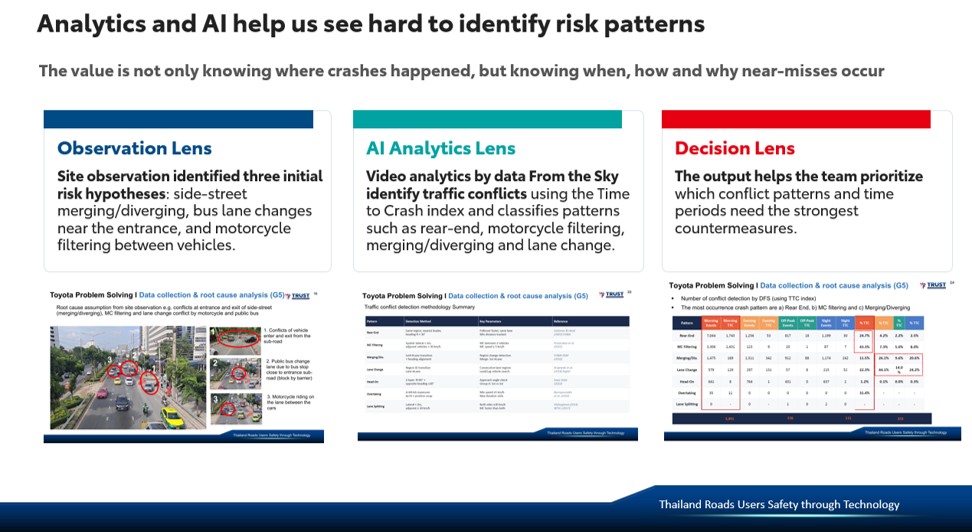
The project also draws on a safety-management principle used in Toyota’s manufacturing operations: unsafe acts and near-misses occur more frequently than serious incidents, so identifying and addressing risks early can help prevent harm. In the road environment, surrogate safety indicators such as Time-to-Collision (TTC) and Post-Encroachment Time (PET) can help screen interactions that warrant closer examination, including situations that may not appear in conventional crash records.
Learning from Implementation: Ratchada Soi 32
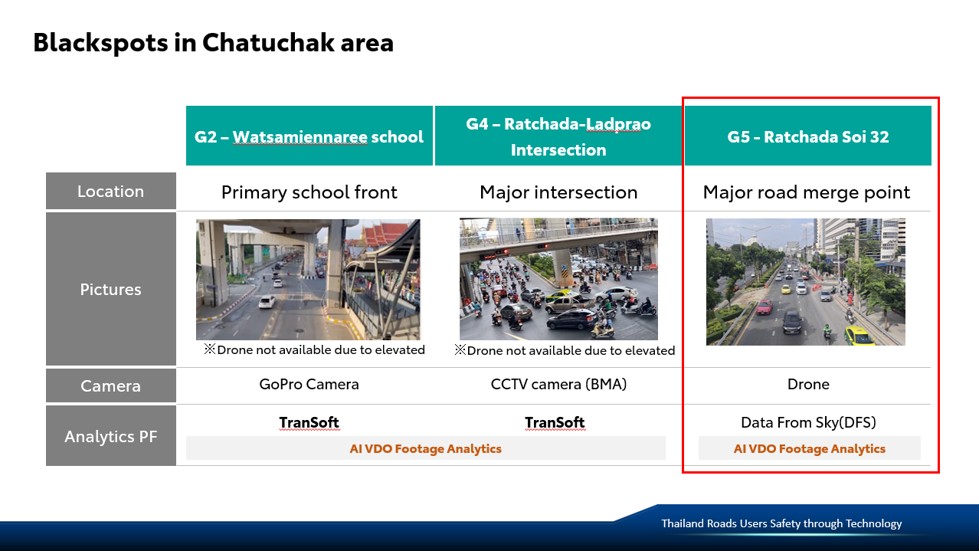
In Bangkok’s Chatuchak district, TRUST selected three trial blackspots in consultation with BMA and AIT: At Wat Samian Naree School (G2), at the Ratchada-Lad Phrao intersection (G4), and at Ratchada Soi 32 (G5). Because each site has different physical conditions and risk patterns, the project uses different data-collection and AI-analysis methods, including GoPro or CCTV footage with Transoft Solutions software at G2 and G4, and drone footage with DataFromSky at G5.
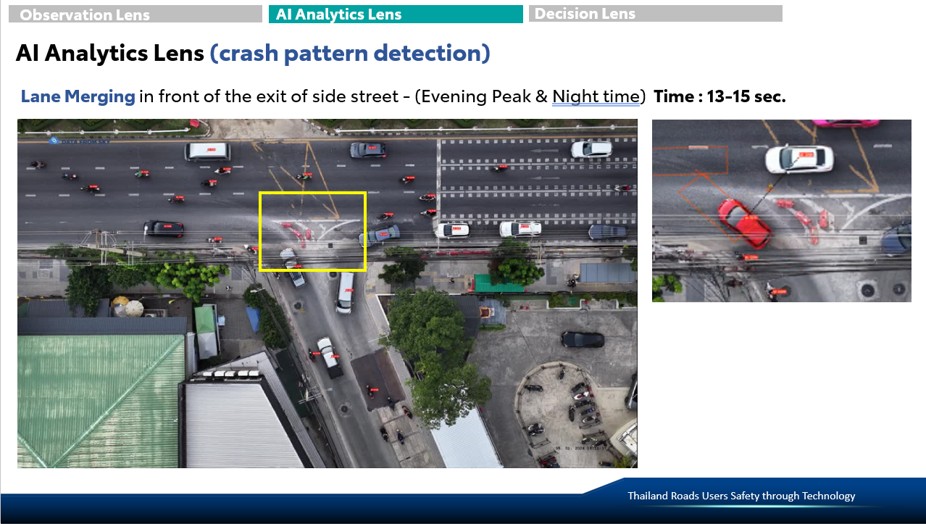
One example of the approach in practice is Ratchada Soi 32 in Bangkok’s Chatuchak district, where analysis identified merging and diverging movements near the side-street entrance as an important area for attention. Drone analysis in December 2025 recorded almost 4,000 vehicles passing during a 30-minute morning peak, with motorcycles accounting for around 62 percent of the traffic. Video analysis and site observations helped the project examine how vehicles moved between the main road and the side street.
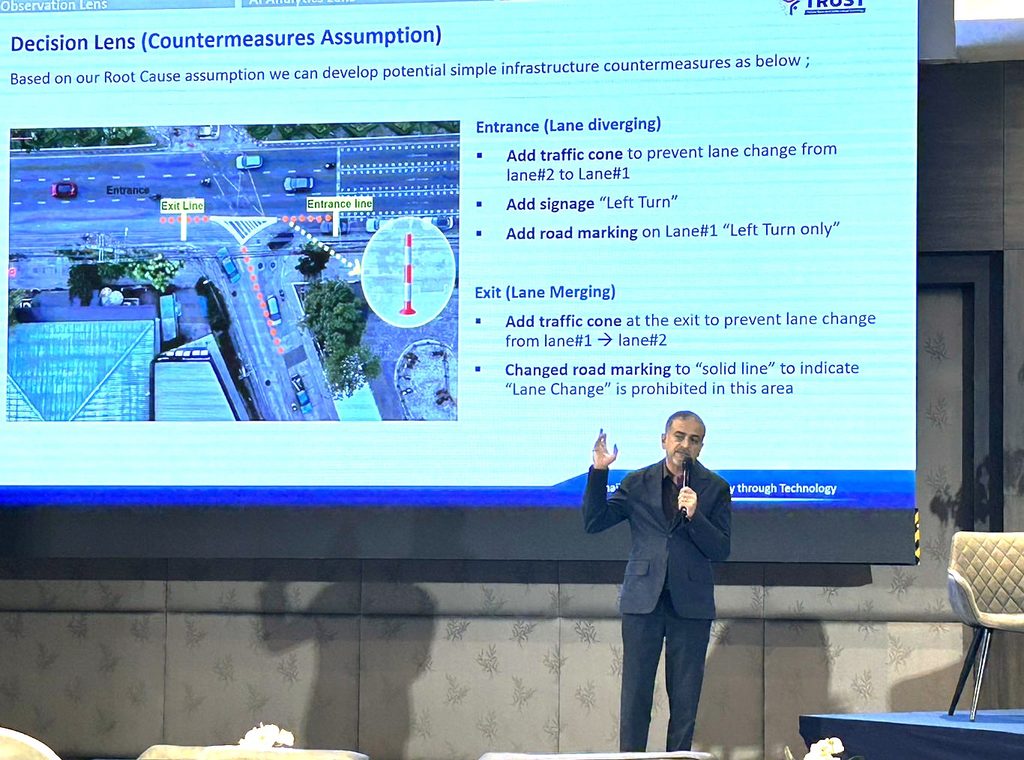
Following the review of data findings with relevant stakeholders, BMA introduced a set of practical traffic-management and road-marking measures at the location. These included traffic cones to discourage late lane changes, blue “Turn Left” road markings and approach signage, and a solid line on the main road near the side-street exit to discourage lane changes.
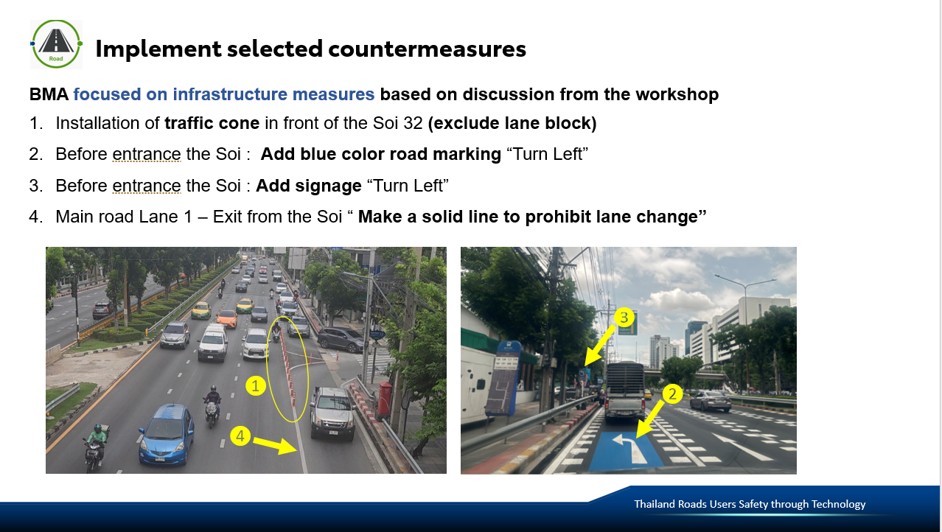
The implementation also illustrates why monitoring is an essential part of the TRUST approach. Initial observations have indicated a possible unintended effect: some motorcycles appeared to slow sharply before the cones when preparing to turn into the side street, potentially creating a rear-end risk for following vehicles. This observation will be examined through a formal evaluation using comparable data sources. The experience reinforces that road-safety measures need to be monitored after implementation and adjusted when evidence points to new or remaining risks.
Building a Model That Can Be Shared
Beyond individual locations, TRUST is intended to demonstrate a repeatable way of using data and technology to support road-safety planning. TMF aims to share the methodology, analytical approach and lessons learned with public agencies and partners, supporting their ability to apply the approach in other districts and provinces. The longer-term ambition is to contribute to safer, more inclusive and more sustainable mobility through solutions that can be adapted to local conditions. TRUST findings are also being considered for future activities under the KUB-DEE-DAI-DEE (KDDD) “Drive Good, Earn Good” campaign, a joint initiative of BMA, Honda and TMF launched in November 2025 that encourages safer driving through positive reinforcement.
About the TRUST Project
Evolving from the insightful discussions of mobility companies and organizations at the Tateshina Meeting in Japan, strategizing on road safety issues, the TRUST Project in Bangkok uses data-driven analytics and technology to identify high-risk accident zones and unsafe driving behaviors with focus on the prioritized focus areas of human behavior, infrastructure and vehicle. The project is a joint initiative of TMF, BMA, TMT, UN-Habitat, AIT, and Thai RVP. Through this initiative, TMF, BMA and its partners aim to create a scalable model for road safety that can be piloted in Bangkok and replicated across Thailand to be shared globally.
About Toyota Mobility Foundation
Toyota Mobility Foundation (Chair Akio Toyoda) was established in August 2014 by Toyota Motor Corporation (Toyota) to support the development of a more mobile society in which everyone can move freely. The Foundation underscores Toyota’s ongoing commitment to continuous improvement and respect for people. It utilizes Toyota’s expertise and technologies to support strong mobility systems while eliminating disparities in mobility. TMF works in partnership with universities, governments, non-profits, research institutions and other organizations, creating programs that are aligned with the UN Sustainable Development Goals (SDGs) to address mobility issues around the world. “TMF aims to create a truly mobile society that will help people live better lives no matter where they are.”, quoted Chair Akio Toyoda.